


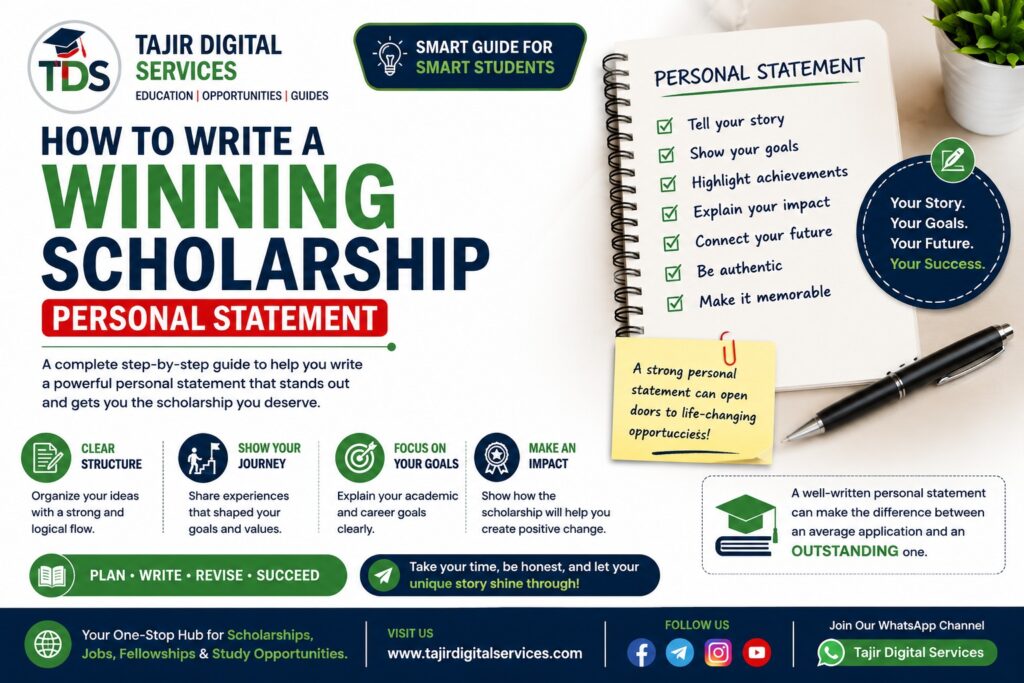
A strong scholarship personal statement can make a major difference in your application. It gives scholarship committees an opportunity to understand who you are, what you have achieved, what motivates you, and why you deserve financial support.
Many students make the mistake of simply listing their grades, achievements, and activities. A successful personal statement should do more than that. It should tell your story clearly and show how your experiences, goals, and values connect with your educational plans.
In this guide, you will learn how to write a compelling scholarship personal statement, what to include, common mistakes to avoid, and how to make your statement more memorable.
What Is a Scholarship Personal Statement?
A scholarship personal statement is a written explanation of your background, experiences, achievements, goals, and motivation for applying for a scholarship.
It allows the selection committee to learn more about you beyond your academic records.
Depending on the scholarship, you may be asked to explain:
- Your educational background
- Your career goals
- Your achievements
- Your leadership experience
- Your community involvement
- Challenges you have overcome
- Why you chose your field of study
- Why you need financial support
- How the scholarship will help you achieve your goals
- How you plan to contribute to your community or society
Always read the specific scholarship instructions carefully because the questions and requirements can differ from one program to another.
How to Start a Scholarship Personal Statement
The beginning of your personal statement is important because it creates the first impression.
Avoid starting with very general statements such as:
“My name is John, and I am applying for this scholarship because education is important to me.”
Instead, begin with something that immediately gives the reader a reason to continue.
You could start with:
- A meaningful experience
- A challenge you faced
- A personal achievement
- A moment that influenced your career choice
- A problem in your community that motivated you
- A specific goal you want to achieve
For example, instead of simply saying that you are interested in environmental science, explain what caused that interest.
A specific story is usually more memorable than a collection of general statements.
Create a Clear Structure Before Writing
Before writing the full statement, create a simple outline.
A useful structure is:
- Introduction
- Educational and personal background
- Achievements and experiences
- Challenges and lessons learned
- Career and academic goals
- Why you are applying for the scholarship
- How the scholarship will help you
- Conclusion
This structure helps you stay focused and prevents the statement from becoming a long list of unrelated information.
1. Write a Strong Introduction
Your introduction should quickly establish who you are and what motivates you.
Instead of trying to impress the committee with complicated vocabulary, focus on being specific and authentic.
For example:
Growing up in a community where access to clean water was a constant challenge shaped my interest in environmental engineering and motivated me to pursue solutions that can improve the lives of others.
This works because it introduces a personal experience, an area of interest, and a future motivation.
Your introduction does not need to tell your entire story. Its main purpose is to introduce the story you will develop throughout the statement.
2. Explain Your Educational Background
After your introduction, explain how your education has prepared you for your future goals.
You can discuss:
- Your current or previous degree
- Relevant courses
- Academic achievements
- Research projects
- Academic competitions
- Skills developed through your studies
- Subjects that influenced your career direction
Do not simply list your qualifications.
Instead, explain how your educational experiences influenced your development.
For example:
Instead of:
I studied biology, chemistry, and environmental science.
You could write:
My studies in biology and environmental science introduced me to the relationship between human activity and ecosystem health, strengthening my interest in developing sustainable environmental solutions.
The second version explains the significance of the experience.
3. Highlight Your Achievements and Experience
Scholarship committees want to understand what you have done with the opportunities available to you.
Your experiences might include:
- Leadership positions
- Volunteer work
- Internships
- Research
- Community projects
- Student organizations
- Employment
- Entrepreneurship
- Academic awards
- Professional certifications
- Competitions
Choose experiences that support your overall story.
You do not need to include every achievement you have ever received.
Ask yourself:
What does this experience show about me?
For example, volunteering may demonstrate commitment to your community, while leading a student organization may demonstrate leadership and communication skills.
4. Discuss Challenges Without Making the Statement Only About Problems
Some scholarship applications ask applicants to describe challenges they have experienced.
If you include a difficult experience, focus not only on what happened but also on what you learned from it.
A useful approach is:
Challenge → Action → Result → Lesson
Explain:
- What challenge did you face?
- What did you do about it?
- What happened as a result?
- What did the experience teach you?
This makes your story more meaningful.
Avoid exaggerating difficulties simply to make your application appear more impressive. Be honest and focus on your growth.
5. Explain Your Career Goals
Your personal statement should give the committee a clear understanding of where you want to go.
Explain:
- What career you want to pursue
- Why you chose that career
- What skills you want to develop
- What problem you want to solve
- How your education connects to your long-term plans
Try to be specific.
Instead of:
I want to become successful and help people.
Consider:
My long-term goal is to work in public health research and contribute to programs that improve access to preventive healthcare in underserved communities.
A specific goal makes your statement more convincing.
6. Explain Why You Need the Scholarship
If the scholarship asks about financial need, answer honestly and clearly.
Explain how receiving financial support would affect your education.
You may discuss expenses such as:
- Tuition
- Accommodation
- Books and learning materials
- Research expenses
- Transportation
- Living costs
However, do not make financial need the only reason you deserve the scholarship.
Connect your need to your educational goals and future contribution.
7. Explain How the Scholarship Will Help You
This is one of the most important parts of your personal statement.
Don’t simply say:
This scholarship will help me achieve my dreams.
Explain how it will help.
For example, the funding may allow you to:
- Continue your studies without significant financial interruption
- Focus more on your academic work
- Conduct research
- Participate in professional opportunities
- Gain specialized training
- Develop skills needed for your career
- Complete a degree that would otherwise be difficult to finance
Show the committee that their investment can create meaningful results.
8. Show Your Future Impact
Strong scholarship applications often connect personal goals with broader impact.
Think about:
What will you do with the opportunity if you receive it?
Your answer might involve:
- Your local community
- Your country
- Your profession
- Scientific research
- Education
- Technology
- Healthcare
- Environmental development
- Social development
You don’t need to promise that you will “change the world.”
A realistic and specific contribution is usually more convincing.
9. Make Your Personal Statement Personal
One of the biggest mistakes applicants make is writing something that could have been written by anyone.
Your personal statement should sound like you.
Include details that are genuinely connected to your experience.
Instead of writing:
I have always been passionate about helping people.
Explain what happened that developed that passion.
Instead of:
I am a hardworking student.
Show evidence of your work ethic through an experience, achievement, project, or challenge.
Show, don’t just tell.
10. Follow the Scholarship Instructions
Before submitting your personal statement, carefully check the requirements.
Look for:
- Word limit
- Character limit
- Specific questions
- Required topics
- Formatting instructions
- File format
- Submission method
- Application deadline
If the scholarship asks a specific question, make sure your statement actually answers it.
A beautifully written personal statement can still be weak if it does not respond to the question asked.
Common Mistakes to Avoid
1. Using the Same Statement Everywhere
A general personal statement may not work for every scholarship.
Customize your statement to match the specific opportunity.
2. Repeating Your CV
Your personal statement should not simply turn your CV into paragraphs.
Your CV lists your experiences. Your personal statement should explain the meaning and impact of those experiences.
3. Using Too Many Complicated Words
You do not need sophisticated vocabulary to sound intelligent.
Clear and natural writing is usually stronger.
4. Making Unsupported Claims
Avoid saying you are “the best,” “exceptional,” or “the perfect candidate” without providing evidence.
Let your experiences demonstrate your strengths.
5. Writing Too Much About Your Childhood
Personal stories can be useful, but they should connect to your current education, goals, or motivation.
Do not spend most of the statement describing events that have little connection to your application.
6. Ignoring the Word Limit
If the scholarship provides a word limit, follow it carefully.
A statement that is far too long can make it appear that you did not follow the instructions.
7. Submitting Without Editing
Spelling and grammar mistakes can distract from an otherwise strong application.
Always review your statement before submission.
How to Make Your Scholarship Personal Statement Stand Out
Use these practical techniques to improve your statement:
Be Specific
Replace general claims with real examples.
Be Authentic
Write in your natural voice while maintaining a professional tone.
Connect Your Experiences
Show how your education, experiences, challenges, and goals fit together.
Focus on Impact
Explain what you learned and what changed because of your actions.
Show Direction
Make it clear where you want your education and career to take you.
Keep the Reader Interested
Use specific examples and meaningful details rather than filling the statement with generic phrases.
Scholarship Personal Statement Checklist
Before submitting your statement, ask yourself:
- Does my introduction immediately explain my motivation?
- Have I explained my educational background?
- Have I included relevant achievements and experiences?
- Have I demonstrated my skills with specific examples?
- Have I explained my academic and career goals?
- Have I clearly explained why I am applying?
- Have I explained how the scholarship will help me?
- Have I shown how I plan to use the opportunity?
- Does the statement answer the scholarship’s specific questions?
- Have I followed the required word or character limit?
- Is the writing clear and easy to understand?
- Have I checked grammar and spelling?
- Does the statement sound like me?
If you can answer “yes” to these questions, your personal statement is likely in a much stronger position.
Final Thoughts
Writing a winning scholarship personal statement is not about using impressive words or telling the committee everything about your life.
It is about presenting a clear, honest, and memorable story.
Explain where you came from, what you have learned, what you have accomplished, what you want to achieve, and how the scholarship will help you move toward those goals.
Most importantly, make the statement personal. Your experiences, motivations, challenges, and ambitions are what distinguish your application from thousands of others.
Take time to plan your ideas, write a first draft, revise it carefully, and make sure every paragraph contributes something meaningful to your application.