


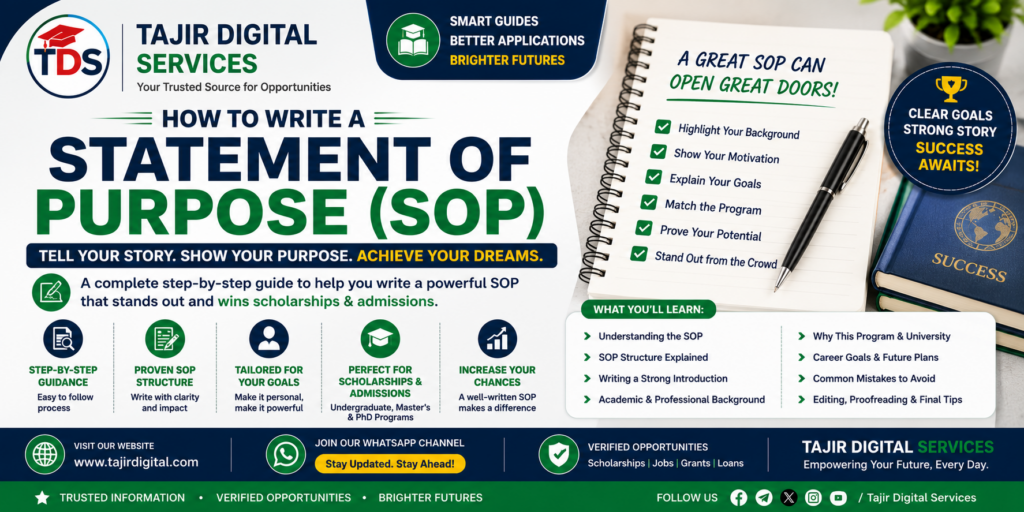
Your Statement of Purpose (SOP) is arguably the single most influential document in your postgraduate university or scholarship application package. While your academic transcripts present past grades and test scores, your SOP provides context—explaining who you are, your academic evolution, your career trajectory, and why you are uniquely qualified for selection.
Selection panels evaluate hundreds of essays daily. A compelling, authentically written SOP can overcome minor academic shortcomings, such as a slightly lower GPA, by showcasing strong leadership potential, clear research intent, and future impact.
📊 Statement of Purpose (SOP) vs. Personal Statement
Understanding the technical distinction between an SOP and a Personal Statement prevents submitting the wrong essay format:
| Parameter / Feature | Statement of Purpose (SOP) | Personal Statement |
| Core Objective | Outlines professional goals, research interests, & academic alignment | Tells a narrative story of personal development & values |
| Primary Focus | Academic history, work milestones, & future career impact | Life experiences, overcoming challenges, & personal growth |
| Tone & Style | Professional, structured, scholarly, & forward-looking | Narrative, reflective, conversational, & human-centered |
| Common Application | Master’s, PhD, fully funded scholarships, & research fellowships | Undergraduate admissions, diversity awards, & humanitarian grants |
🛠️ The Standard 5-Paragraph SOP Framework
A winning Statement of Purpose maintains a logical flow, typically spanning 800 to 1,000 words (1.5 to 2 pages) structured into five distinct paragraphs:
  ┌──────────────────────────────────────────────────────────┐
  │ 1. THE HOOK & INTRODUCTION (Core Intent)                 │
  └─────────────────────────────┬────────────────────────────┘
                                │
  ┌─────────────────────────────▼────────────────────────────┐
  │ 2. ACADEMIC FOUNDATIONS & RESEARCH EXPERIENCE            │
  └─────────────────────────────┬────────────────────────────┘
                                │
  ┌─────────────────────────────▼────────────────────────────┐
  │ 3. PROFESSIONAL EXPERIENCE & LEADERSHIP IMPACT           │
  └─────────────────────────────┬────────────────────────────┘
                                │
  ┌─────────────────────────────▼────────────────────────────┐
  │ 4. PROGRAM & INSTITUTION ALIGNMENT (The "Why")           │
  └─────────────────────────────┬────────────────────────────┘
                                │
  ┌─────────────────────────────▼────────────────────────────┐
  │ 5. CAREER VISION & CLOSING COMMITMENT                    │
  └──────────────────────────────────────────────────────────┘
Paragraph 1: The Hook & Introduction
Avoid starting with generic quotes or childhood anecdotes. Open with an engaging hook that introduces your core academic interest, current field, and immediate objective for applying to the program.
Paragraph 2: Academic Foundations & Research
Highlight relevant undergraduate or postgraduate training, your capstone thesis, key academic honors, and analytical competencies. Demonstrate your capacity for rigorous academic inquiry.
Paragraph 3: Professional Experience & Practical Leadership
Detail internships, full-time employment, or volunteer projects. Emphasize active contributions using quantifiable metrics rather than listing basic routine duties (e.g., “Coordinated a regional research survey involving over 500 respondents”).
Paragraph 4: Program & Institutional Alignment (The “Why”)
This section must be customized for every single application. Name specific university professors, specialized research laboratories, or unique course modules that align precisely with your goals.
Paragraph 5: Career Roadmap & Conclusion
Clearly articulate your immediate post-graduation plans and long-term 5-to-10-year vision. Explain how the knowledge gained will help solve specific challenges within your home country or industry upon completion.
⚠️ 6 Mistakes That Lead to Instant Rejection
- Plagiarism & Copy-Pasting: Copying essays from online templates or peers results in immediate, permanent disqualification.
- Unedited Generative AI Content: Submitting raw AI-generated text lacks personal authenticity, specific real-world examples, and human voice.
- Generic Institutional Praise: Avoid flattery such as “Your university is the best in the world.” Instead, reference verified academic offerings and faculty research.
- Exceeding Prescribed Word Limits: Disregarding strict length parameters demonstrates an inability to follow basic instructions.
- Excessive Unrelated Details: Omit childhood memories, family struggles, or personal information that bears no relevance to your academic discipline.
- Failure to Customise: Sending a single, generic SOP to multiple universities without changing institution-specific details guarantees rejection.
💡 Expert Writing Strategy: “Show, Don’t Tell”
Instead of stating generic claims, back up every statement with concrete evidence:
- ❌ Weak Statement: “I am a dedicated leader with excellent project management skills.”
- ✅ Strong Statement: “As Lead Coordinator for the campus tech initiative, I managed a team of 8 volunteers to organize a regional hackathon attracting 150+ participants.”
📋 Final Pre-Submission Audit Checklist
Before uploading your SOP to any application portal, verify these critical points:
[ ] Saved and uploaded in clean PDF format (e.g., FirstName_LastName_SOP.pdf).
[ ] Essay adheres strictly to the university’s word count guidelines (typically 500–1,000 words).
[ ] Tone remains professional, scholarly, and confident throughout.
[ ] Paragraph 4 specifically mentions target course modules, professors, or university facilities.
[ ] Career goals directly connect to the skills taught in the program.
[ ] Document has been proofread for spelling, grammar, and sentence flow.