


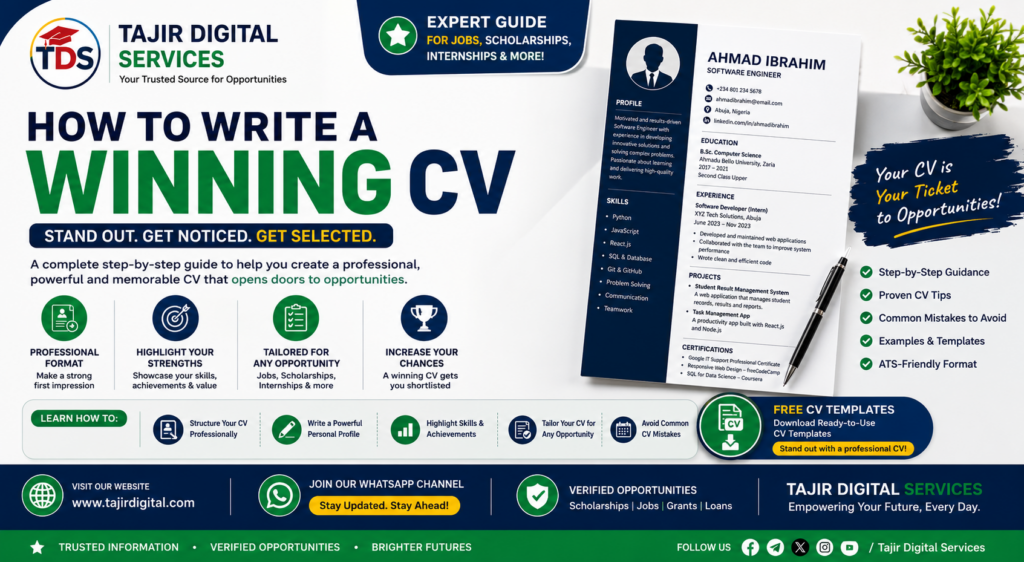
Whether you are applying for competitive job vacancies, international fully funded scholarships, or global fellowships, your Curriculum Vitae (CV) serves as your primary personal marketing document. An Applicant Tracking System (ATS) or human reviewer takes fewer than six seconds to decide if your profile warrants further evaluation.
A winning CV goes beyond listing basic duties—it presents your skills, leadership impact, and academic achievements in a structured, professional, and result-oriented layout.
📊 CV vs. Resume: Core Differences
Selecting the correct document format depends on the specific opportunity and target region:
| Feature / Metric | Curriculum Vitae (CV) | Standard Resume |
| Document Length | Comprehensive (2 or more pages) | Concise (Strictly 1–2 pages) |
| Primary Focus | Complete academic history, research, publications & career credentials | Specific skills and work experience relevant to a single job |
| Best Application Use | Scholarships, academic roles, grants, fellowships & postgraduate study | Corporate private-sector job applications |
| Target Audience | Selection committees, university admissions, and academic panels | Hiring managers, recruiters, and corporate talent acquisition |
🛠️ 8 Essential Sections of a Winning CV
1. Contact Header & Professional Details
Place these details clearly at the top of your document:
- Full Name: Prominent 14–16pt bold font.
- Professional Email Address: Use clean naming formats (e.g.,
firstname.lastname@email.com). - Phone Number: Include your international country code (e.g.,
+234). - Location: City and Country of residence (full physical home addresses are obsolete).
- Digital Profiles: Clean, updated LinkedIn URL or online portfolio link.
Privacy Advisory: Omit sensitive personal data such as marital status, religion, age, state of origin, or national identity numbers unless specifically mandated by regional guidelines.
2. Professional Summary
Write a powerful 3 to 4-sentence overview highlighting your core technical competencies, career milestones, and value proposition:
“Results-driven Data Analyst with over 3 years of experience transforming complex datasets into actionable business intelligence. Proven track record in Python, SQL, and Power BI visualization, leading cross-functional teams to improve operational efficiency by 25%. Seeking to leverage technical expertise within competitive fellowship research initiatives.”
3. Academic Background & Qualifications
List your academic history in reverse-chronological order (most recent first):
- Name of Institution & City/Country
- Degree Earned (e.g., B.Sc. Computer Science – First Class Honours)
- Graduation Date or Expected Completion Year
- Notable Academic Honors, High GPAs, or relevant capstone thesis projects
4. Work & Internship Experience
Focus on action verbs and quantifiable achievements rather than passive duty descriptions:
- Job Title & Organization: State your exact designation and company name.
- Timeline: Month and Year format (e.g., March 2024 – Present).
- Bullet Point Formula:
[Action Verb] + [Specific Task] = [Quantifiable Result]- Example: “Engineered an automated record management system, reducing data processing delays by 35% across 4 regional branches.”
5. Technical & Interpersonal Skills
Categorize your strengths cleanly to help recruiters scan quickly:
- Hard/Technical Skills: Python, Data Analysis, SEO Management, Financial Modeling, UI/UX Design, AutoCAD.
- Soft/Transferable Skills: Cross-cultural Communication, Strategic Leadership, Conflict Resolution, Time Management.
6. Certifications & Professional Licenses
Highlight industry-recognized training that proves ongoing professional development (e.g., Google Career Certificates, PMP, ACCA, AWS Certified Cloud Practitioner).
7. Leadership & Community Volunteering
Scholarship and fellowship panels value civic engagement. Detail volunteer experience by stating your specific role, the organization, and the community impact generated.
8. Honors, Awards & Publications
List merit-based awards, Dean’s List placements, hackathon victories, or peer-reviewed research papers with full citation details.
🎯 Customized CV Strategies by Applicant Profile
  [Students & Fresh Graduates] ──► Prioritize Education, Academic Projects & Volunteer Roles
  [Mid-Career Professionals]   ──► Prioritize Quantifiable Work Impact & Leadership Growth
  [Scholarship Applicants]     ──► Prioritize Research Proposals, Publications & Community Impact
⚠️ 6 Costly CV Errors to Avoid
- Ignoring ATS Compatibility: Graphic elements, multi-column tables, and image files confuse automated scanner software. Stick to clean, single-column layouts.
- Submitting Uncustomized Generic CVs: Always adjust your key skills and bullet points to match the exact keywords in the target job posting or scholarship criteria.
- Using Unprofessional Emails: Email handles with informal nicknames create a poor first impression.
- Vague Accomplishments: Avoid phrases like “responsible for managing inventory.” Instead, state “managed a ₦5,000,000 monthly inventory budget with zero record discrepancies.”
- Typographical and Formatting Errors: Inconsistent font sizes, varied bullet points, and grammar mistakes reflect poorly on your attention to detail.
- Incorrect File Formatting: Save and submit your CV as a PDF file to preserve layout formatting across all devices, unless Word (.docx) is explicitly requested.
📋 Final Pre-Submission Verification Checklist
Before uploading your CV to any application portal, verify these critical points:
[ ] File is saved in clean PDF format using a professional title (e.g., FirstName_LastName_CV.pdf).
[ ] Contact phone number includes international country code.
[ ] Professional summary is tailored specifically to the target role or award.
[ ] Work experiences begin with strong, active verbs.
[ ] Achievements include concrete numbers, percentages, or metrics.
[ ] Spelling, punctuation, and layout spacing are thoroughly proofread.