


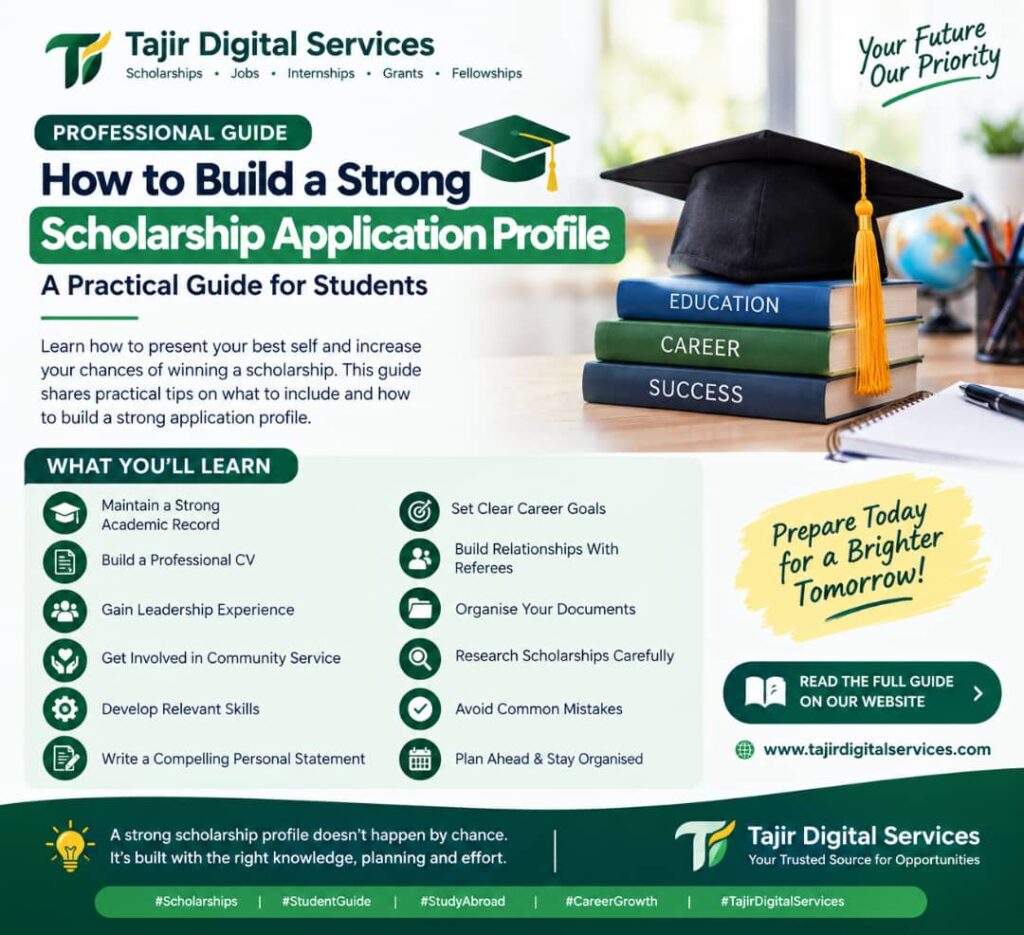
Winning a scholarship is not only about having good grades. Many scholarship programmes consider the applicant as a whole, including academic performance, leadership, community involvement, career goals, personal achievements and the quality of the application.
A strong scholarship profile helps you present your qualifications clearly and demonstrate why you are a suitable candidate.
This guide explains the important areas students should develop before applying for scholarships.
1. Maintain a Strong Academic Record
Academic performance remains an important part of many scholarship applications.
You should:
- Take your studies seriously.
- Maintain good grades throughout your programme.
- Improve weak subjects where possible.
- Keep copies of your academic transcripts and certificates.
- Participate in academic projects and activities.
If your academic results are not perfect, do not automatically assume that you cannot receive a scholarship. Some opportunities consider leadership, financial need, community service, research potential or other factors.
2. Build a Professional CV
Your CV should make it easy for a scholarship committee to understand your background.
A good scholarship CV can include:
- Education
- Work experience
- Internships
- Volunteer experience
- Leadership positions
- Professional skills
- Certifications
- Awards and achievements
- Research or academic projects
- Relevant extracurricular activities
Keep the CV organised and make sure the information is accurate.
Avoid adding skills or experiences that you cannot demonstrate.
3. Develop Leadership Experience
Leadership does not necessarily mean holding a major political or organisational position.
You can demonstrate leadership through:
- Student organisations
- Community projects
- Volunteer activities
- Youth organisations
- School associations
- Religious or community initiatives
- Organising educational activities
- Leading academic or professional projects
What matters is being able to explain what you did, what problem you addressed and what result you achieved.
4. Get Involved in Community Service
Many scholarship providers are interested in applicants who contribute to their communities.
Look for genuine opportunities to:
- Volunteer with community organisations
- Support educational activities
- Participate in environmental projects
- Mentor younger students
- Support health or awareness campaigns
- Organise community initiatives
Do not participate in activities simply to fill your CV. Choose activities that genuinely interest you and keep evidence of your involvement.
5. Build Relevant Skills
Develop skills that support your academic and career goals.
Depending on your field, useful skills may include:
- Communication
- Research
- Leadership
- Teamwork
- Problem-solving
- Digital skills
- Data analysis
- Project management
- Public speaking
- Writing
Online courses and professional certifications can also strengthen your profile when they are relevant and genuine.
6. Prepare a Strong Personal Statement
The personal statement is often one of the most important parts of a scholarship application.
Instead of simply writing:
“I need this scholarship because I want to study abroad.”
Explain:
- Who you are
- What you have achieved
- What you want to study
- Why you selected the programme
- What challenges you have overcome
- What your career goals are
- How the scholarship will help you
- How you intend to contribute to your community or field
Your statement should sound like you, not like a generic template copied from the internet.
7. Develop Clear Career Goals
Scholarship committees want to understand what you intend to do with the opportunity.
Think about:
Where am I now?
What do I want to learn?
What career do I want to pursue?
How will this scholarship help me achieve that goal?
How will my education benefit others?
Having clear answers will make your application more convincing.
8. Build Relationships With Potential Referees
Many scholarships require recommendation letters.
Start building professional relationships with:
- Lecturers
- Professors
- Academic supervisors
- Employers
- Project supervisors
- Professional mentors
Choose people who know your work or character well enough to provide a meaningful recommendation.
Do not wait until the application deadline before contacting your referees.
9. Organise Your Documents
Create a folder on your phone, computer or cloud storage containing your important application documents.
Your folder may include:
- International passport
- National identification document where required
- Academic certificates
- Academic transcripts
- CV
- Personal statement
- Recommendation letters
- English-language test results where required
- Professional certificates
- Portfolio or research documents where applicable
Check the requirements of each scholarship because documents vary between programmes.
10. Research Scholarships Carefully
Do not apply for every scholarship you see.
Before applying, check:
- Eligibility requirements
- Nationality requirements
- Academic requirements
- Age restrictions
- Field of study
- Study level
- Funding coverage
- Application deadline
- Required documents
- Official application website
Always confirm important information from the scholarship provider’s official website.
11. Avoid Using One Application for Every Scholarship
Different scholarships have different objectives.
For example, one scholarship may focus on:
- Academic excellence
while another may prioritise:
- Leadership
- Financial need
- Research
- Community development
- Women in STEM
- Public service
- Entrepreneurship
Adapt your application to the specific scholarship rather than submitting exactly the same personal statement everywhere.
12. Review Your Application Before Submission
Before clicking the submit button, check everything carefully.
Application Checklist
☐ I meet the eligibility requirements.
☐ I selected the correct programme.
☐ My CV is updated.
☐ My personal statement is relevant.
☐ My documents are complete.
☐ My recommendation letters are arranged.
☐ My information is consistent across documents.
☐ I followed the required format.
☐ I checked the deadline and time zone.
☐ I am applying through the official application portal.
Common Mistakes to Avoid
Avoid these mistakes when applying for scholarships:
- Applying without checking eligibility
- Using false information
- Copying another person’s personal statement
- Submitting an outdated CV
- Ignoring document requirements
- Waiting until the final hours to apply
- Applying through suspicious websites
- Paying unofficial individuals to “guarantee” a scholarship
- Using poor-quality or incomplete documents
- Sending the same generic application everywhere
How Far in Advance Should You Prepare?
Ideally, begin preparing your scholarship profile several months before the application deadline.
A simple preparation plan could look like this:
3–6 months before:
Improve your CV, skills, academic profile and experience.
1–3 months before:
Research suitable scholarships and prepare your documents.
2–4 weeks before:
Work on your personal statement and recommendation letters.
1 week before:
Complete the application and carefully review everything.
Before the deadline:
Submit early and save evidence of your submission.
Final Thoughts
A strong scholarship application profile is built over time. Good grades are valuable, but they are only one part of your overall profile.
Develop your academic record, gain meaningful experience, build useful skills, participate in genuine community activities and clearly define your career goals.
Most importantly, do not wait for a scholarship announcement before starting to build your profile. The strongest applicants often prepare long before the application opens.
When you find a scholarship opportunity, carefully read its official requirements and present your genuine achievements in a clear and professional way.