


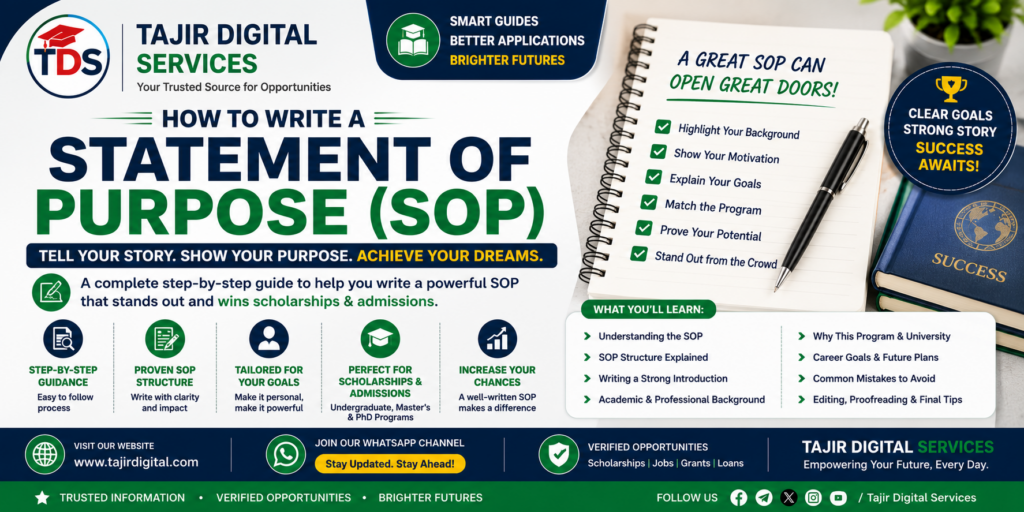
Learn how to write a powerful Statement of Purpose (SOP) for scholarships and university admissions. Get the complete structure, expert tips, and common mistakes to avoid
A Statement of Purpose (SOP) is one of the most critical documents required when applying for scholarships, postgraduate programs, fellowships, internships, and international university admissions. It gives you the unique opportunity to introduce yourself beyond your grades and test certificates—explaining your academic background, career goals, core motivations, and exactly why you are the ideal candidate.
Many brilliant applicants lose out on life-changing opportunities simply because they submit poorly written, generic, or plagiarized SOPs. A truly winning Statement of Purpose should tell your unique story, demonstrate your authentic passion, and clearly show how the academic program aligns with your future ambitions.
In this comprehensive step-by-step guide, you’ll learn how to structure an effective SOP, what essential information to include, common mistakes to avoid, and practical tips to maximize your chances of success.
Table of Contents
- What is a Statement of Purpose (SOP)?
- Why is an SOP Important?
- Difference Between an SOP and a Personal Statement
- The Structure of a Winning SOP
- Step-by-Step Guide to Writing Your SOP
- Common Mistakes to Avoid
- Expert SOP Writing Tips
- Standard 5-Paragraph SOP Sample Structure
- Frequently Asked Questions
- Conclusion
A Statement of Purpose (SOP) is a formal, personal essay that explicitly details:
- Who you are as an aspiring scholar and professional.
- Your specific academic background and achievements.
- Your short-term and long-term career aspirations.
- Why you chose this exact academic program.
- Why you selected this specific university.
- Why you deserve to be awarded a scholarship or admission slot.
Think of it this way: While your CV lists your academic and professional achievements, your SOP explains the story, drive, and context behind those achievements.
Admissions committees and scholarship boards review hundreds of applications daily. They read your SOP to evaluate factors that numbers on a transcript cannot show:
- Your authentic motivation and passion.
- Your intellectual and academic potential.
- Your long-term career vision.
- Your written communication and presentation skills.
- Your cultural and academic suitability for the program.
A well-crafted SOP can rescue an application, making up for a slightly lower GPA or test score by showcasing massive potential.
While similar, they serve slightly different functions:
- Statement of Purpose (SOP): Highly professional and goal-oriented. It focuses strictly on your academic achievements, research interests, and career trajectory. It is the standard requirement for Master’s and PhD programs.
- Personal Statement: More personal, narrative-driven, and emotional. It highlights your life experiences, challenges overcome, values, and personal journey. It is more commonly used for undergraduate admissions or specific humanitarian fellowships.
💡 Pro-Tip: Always read the university application guidelines carefully to see which exact essay type is being requested.
To keep the admissions committee engaged, structure your SOP logically across these essential sections:
1. The Introduction
Hook the reader immediately. Introduce your background briefly and state your clear interest in pursuing the specific course.
2. Academic Background & Foundations
Discuss your previous educational history. Mention relevant coursework, major academic achievements, your thesis topic (if applicable), and your emerging research interests.
3. Professional Experience & Impact
If you have work experience, describe your jobs, internships, or volunteer activities. Focus on leadership roles and show how these professional experiences have prepared you for advanced study.
4. Why This Specific Program & University?
Explain why you chose this exact course. Avoid generic praise like “Your university is highly ranked.” Instead, reference specific course modules, specialized lab equipment, or faculty professors whose research you admire.
5. Career Goals & Future Vision
Detail your definitive plans. Where will you work immediately after graduating? What is your 5-year or 10-year goal? Show the committee that you have a practical roadmap.
6. The Conclusion
End with a strong, confident, and polite summary. Reaffirm your enthusiasm for the program and thank the committee for their time and consideration.
- Step 1: Research the Program Deeply: Before writing a single word, look up the course modules, faculty professors, and university core values.
- Step 2: Brainstorm Your Unique Narrative: Think about exactly why you chose your field, the challenges you have overcome, and your proudest career milestones.
- Step 3: Write a Raw First Draft: Focus entirely on getting your ideas out onto the page clearly. Do not obsess over perfection on day one.
- Step 4: Edit, Polish, and Refine: Read through your SOP multiple times. Check strictly for grammatical accuracy, spelling errors, clear flow, and logical transitions.
- ❌ Plagiarism: Copying an SOP from the internet or a friend results in instant, permanent disqualification.
- ❌ Lazy AI Text: Using raw, unedited AI output that lacks your personal voice, human emotion, and real-life examples.
- ❌ Exaggerating Achievements: Keep your claims honest and factual; admissions boards easily spot fabricated accomplishments.
- ❌ Irrelevant Personal Data: Including unnecessary childhood details or personal family histories that do not relate to your degree.
- ❌ Ignoring Limits: Writing a massive, wordy essay that completely violates the specified word or page limits.
- ❌ Zero Proofreading: Submitting an essay riddled with lazy typos and spelling errors.
- ✅ Be Authentic: Write in your true voice—honesty stands out.
- ✅ Keep it Simple: Use clear, professional, and elegant language. Avoid overly complex vocabulary words.
- ✅ Show, Don’t Tell: Instead of just saying “I am a hard worker,” show it by saying “I successfully organized a regional academic seminar for 200 participants.”
- ✅ Tailor Every Essay: Never send the exact same SOP to two different universities. Customize the university-specific section for every application.
If you are stuck, follow this classic layout:
- Paragraph 1: Introduction, your academic focus, and immediate hook.
- Paragraph 2: Academic background, relevant university projects, and key honors.
- Paragraph 3: Professional work experience, internships, or volunteering milestones.
- Paragraph 4: Explicit reasons for choosing this university and specific course modules.
- Paragraph 5: Clear career goals, long-term impact statements, and your conclusion.
How long should a Statement of Purpose be?
Most international universities require a length between 500 and 1,000 words (typically 1 to 2 pages). Always review the specific guidelines provided on the application portal.
Can I reuse my SOP for multiple university applications?
No. While your personal background paragraphs can stay the same, the sections explaining why you want to study at that specific university must be customized every single time.
Should I address a lower GPA in my SOP?
Yes, but briefly. Do not make excuses. Instead, explain the situation factually in 2–3 sentences, highlight how you overcame it, and point out your upward academic trend or professional success since then.
Is an SOP compulsory for all applications?
For almost all fully funded international scholarships, Master’s degrees, and PhD applications, a high-quality SOP is mandatory.
Your Statement of Purpose is your ultimate opportunity to tell your story and show who you are beyond mere transcripts and certificate classifications. A thoughtful, well-organized, and compelling SOP will set you apart from thousands of applicants globally.
Take your time, draft early, write with absolute honesty, and tailor your essay to the opportunity. Your story is entirely unique—make sure your Statement of Purpose does it justice!